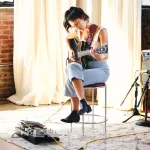
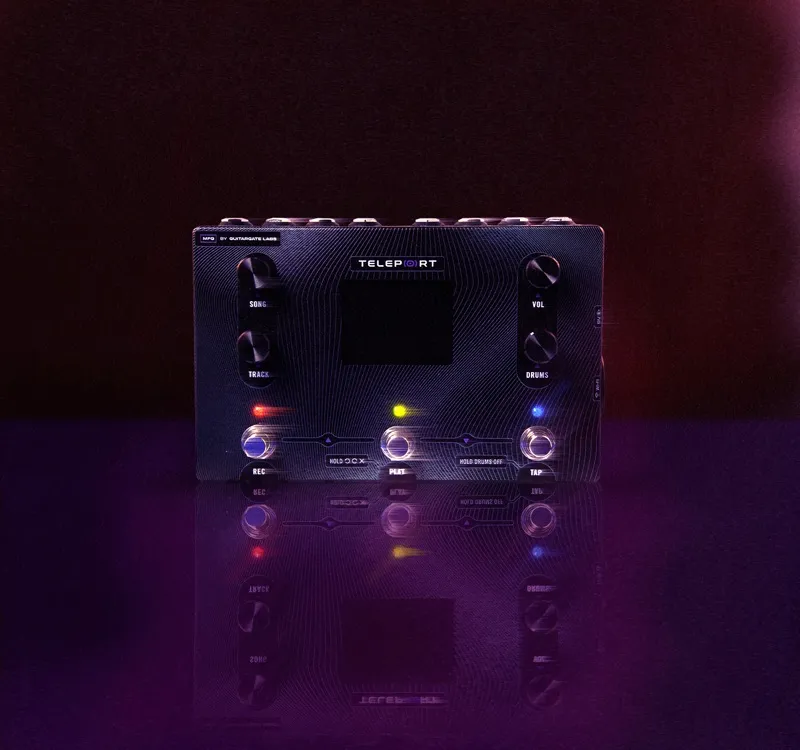
I am just so excited to have Dr. Molly Miller as our newest Teleport instructor! In this lesson, she creates a "sneaky" little groove and chord changes. Watch the video, download the tune, and give it a shot! I can't wait to hear your versions!! - Michael
Drums: 80 BPM, 1/8 note 4 on the floor.
Track1: Dma7, Ami7, Gma7 rhythm guitar parts (I Ma7, V Mi7, IV Ma7)
Track 2: Arpeggiated Bass Part
Track 3: Arpeggiated upper 9th chord extentions
Track 4: Guitar Solo!
Transcript
AI summary
In this engaging masterclass, guitarist and educator Molly Miller demonstrates her creative approach to building a layered guitar composition from the ground up. Working with host Michael Palmisano, she constructs a track called "Oranges" — a groovy, harmonically rich piece built on a foundation of D major 7, A minor 7, and G major 7 chords over an eighth-note, four-on-the-floor drum pattern at 80 BPM.
Molly begins by explaining her chord choices, highlighting the emotional quality of the "five minor" chord and sharing her love for colorful harmonic movements. She methodically layers the track, starting with rhythm guitar strumming the chord progression, then adding a melodic bass line that outlines the root, third, and fifth of each chord to create movement and depth.
The third layer introduces arpeggiated guitar using a clever technique where the same fingering shape moves across the fretboard, creating D major 7, A minor 9, and G major 7 voicings. This "sneaky" approach demonstrates how small positional shifts can yield beautiful harmonic variations without changing hand positions dramatically.
For the final soloing layer, Molly breaks down her improvisational approach using three different pentatonic scales — D major, A minor, and G major — that correspond to each chord change. She offers practical advice for players at different skill levels, from simply moving between positions to eventually finding all three scales within a single area of the fretboard.
Throughout the masterclass, Molly's teaching style balances technical precision with humor and accessibility, emphasizing that music should be enjoyable and expressive rather than overly serious. Her demonstration provides viewers with practical tools for composition, improvisation, and understanding how to build rich, layered guitar parts that work together cohesively.
Full transcript
My friends, Michael Palmisano here again, and I'm here with my friend. Is it Dr. Molly Miller? It is. Do you go by Dr. Molly Miller? So rarely, but I accept it. Well, Molly is not only one of my favorite guitar players in the game, but she's also one of the nicest people and one of the best teachers that I know. Aw, thank you. It's true. I am touched. Thank you. And I am really pumped to have her come and get involved with the Teleport community. And so she has made a dozen tracks for us that you'll be able to download to your pedal and jam along with, and she's going to teach you how she puts the parts together, what she's thinking about, and how you can recreate them. So for all you members out there, you're going to get an email each week, and you'll be able to download one. But she's going to do one live on the fly for us right now. So what's this one called, Molly? Oh, man, this one is called Oranges. Oranges? Just straight-up oranges? Yeah. Gosh, now I feel like it's on the spot. I'm good with oranges. Oranges. I'll let you do your thing. So give me the drum groove. Okay, great. Okay, so drum groove we got eighth note, four on the floor at 80 BPM. I like it. Just that. Yeah. A little groovy. Yeah. Because we have some spicy changes. Okay. We got D major 7, and then we're going to go to A minor 7. I love what they call a five minor. Mm-hmm. So nice. Mm-hmm. And then we're going to bring it down to the four chord, which is G major 7. So those three chords. That's it. I can dig it. Okay, cool. So should we layer track number one, which I will just be jamming out, strumming those three chords. Here we go. That's it. One more time. A bar of D major 7, A minor 7, G major 7. Yeah, that minor 5 is sick. Isn't it? It's great. My problem is I use it too much because I love it so much. It's like, "Ah, I feel-" Even in songs where it's like you have a dominant 5 and you're just like, "Whatever." Yeah. It's just like, "Ah, I feel things." I feel like that's what it is. It's like I have emotions. Yeah. That's one of those things where I always tell people, there are certain changes, like if you have a dominant 3 or something. Another juicy one I love. Right? It's one where you hear that sound, and even as a listener, you're like, "What is that sound?" Yep. And put a word to it. Yes. And just remember it. So like this one, a minor 5, that sound- A little sad ... put it in your bag. Yeah. You know? You actually nailed my favorite is three dominant, five minor, and then four minor if you want to get real sad. Yeah. Doing the Beatles thing. Yeah. It's so good. Yeah. Okay, should I lay down some bass? Hit me. Okay. So bass, we're going to hit the root and the 3, and the 5. I'm into the Spell it out. Because we have a minor 3rd. So we have one major 3-5 for D, one minor 3-5 for A, one major 3-5 for G. Yeah. And just roots are cool too, but I sometimes think it's nice in the bass to also hit some of those chord tones. Totally. So let's do it. Again. There we go. Just like that. Okay, I'm going to do something sneaky now for this next guitar part. It's not sneaky. All right. Yeah. And so D major 7, just this arpeggio root 3-5-7, but something cool that happens for A minor is if you move the shape down a whole step Mm-hmm. With A in the bass, we now have an A minor 9 chord because we have, now I'm going to go into numbers, the flat 3rd, the 5th, the flat 7, and the 9, which is really pretty. I love that. I love that you say sneaky. Those close little moves where you can just move the same shape up or down a fret to get to everything. Yes. That's where the gold is. I know. So we're actually not even going to change our fingering the whole time. So we just go D major 7, A minor 9 now. Yeah. G major 7. Perfect. Okay. So we're going to arpeggiate that out for our third track, which is this extra pretty arpeggios, get some color in there. So again. Mm-hmm. That's great. So close. Just like that. It's vibing. Yeah. I know. It's like you're eating some oranges next to a pool or something, you know? I forgot that you called it oranges. How could I forget? It's such a perfect name. Okay, cool. All right. Last track. What you got? Shred? Shred, melody. Yeah. Whatever you want. I was just going to solo. Go for it. How do they solo over this? So how do we solo over this? So we're going to have to do some things. That's my one warning. For this, we're going to start with one way, and then I'll give you more ways. But one way is just you can think D major pentatonic, A minor pentatonic, and then G major pentatonic. Can we do that? Three pentatonic scales? Of course you can, as long as you connect them. Ooh. Okay. So I'd say to start, if this is feeling crazy and if you just know one pentatonic- Yes ... off of the 6th string, just do your D major pentatonic scale. Move to your A minor pentatonic scale. Move to your G major pentatonic scale. Now, it could feel really crazy, but just go along with me. I'll shout them out at first to help you out. And then once you're feeling cool, then you can start to add more shapes, so you don't have to run over your instrument so much, going from one position to the next, to the next. Because then you can eventually just be like D major pentatonic right here to A minor, I'm not even moving, to G major. Or anywhere, D major pentatonic to A minor pentatonic, to G major pentatonic. It all lives right there. So I'd say one thing at a time, and you can work your way towards that. But we're just going to be jamming out on three different pentatonics. Here we go. A minor pentatonic. G major pentatonic. One more time, D major. A minor. You can also think of A minor as C major. You can think C major pentatonic, C major pentatonic, G major pentatonic. So another way. Now I'm going to do some... I'm not going to do too much. Just underwhelmed. Yes. There we are. I just love the sense of humor in your playing. Thank you. Everything's so serious all the time. Nothing is serious. Everything is fleeting and humorous. Everything is fleeting. Oranges. Just oranges. Love it. Well, Molly, thank you so much for coming to do this. Oh my God, I was so happy you asked. I'm so happy to be here. Yeah. No, it is my pleasure. And for everybody out there, if you want to jam along with Molly and you want to jam along with the community and try to recreate these each week with her, with me, and all of our other instructors, the link will be in the description. And again, for all those that join Teleport, when you become a member, the pedal is actually free, and it is yours to keep. The whole idea is to get us all playing songs and getting us to play songs together. And so I'm just thrilled that you're a part of it. Oh my God, heck yeah. And have fun with these tunes, and that's it. I'll see you around the way. Yeah. Can't wait to hear what they do with Oranges. That's it. Take care. Cheers.
Included with Teleport Music Membership — the full video, transcript, downloads, and practice songs. Create a free account to preview, or sign in if you already have one.